
From the video · natural beekeeping with Dr. Leo Sharashkin
Nine mistakes, and how to avoid each one.
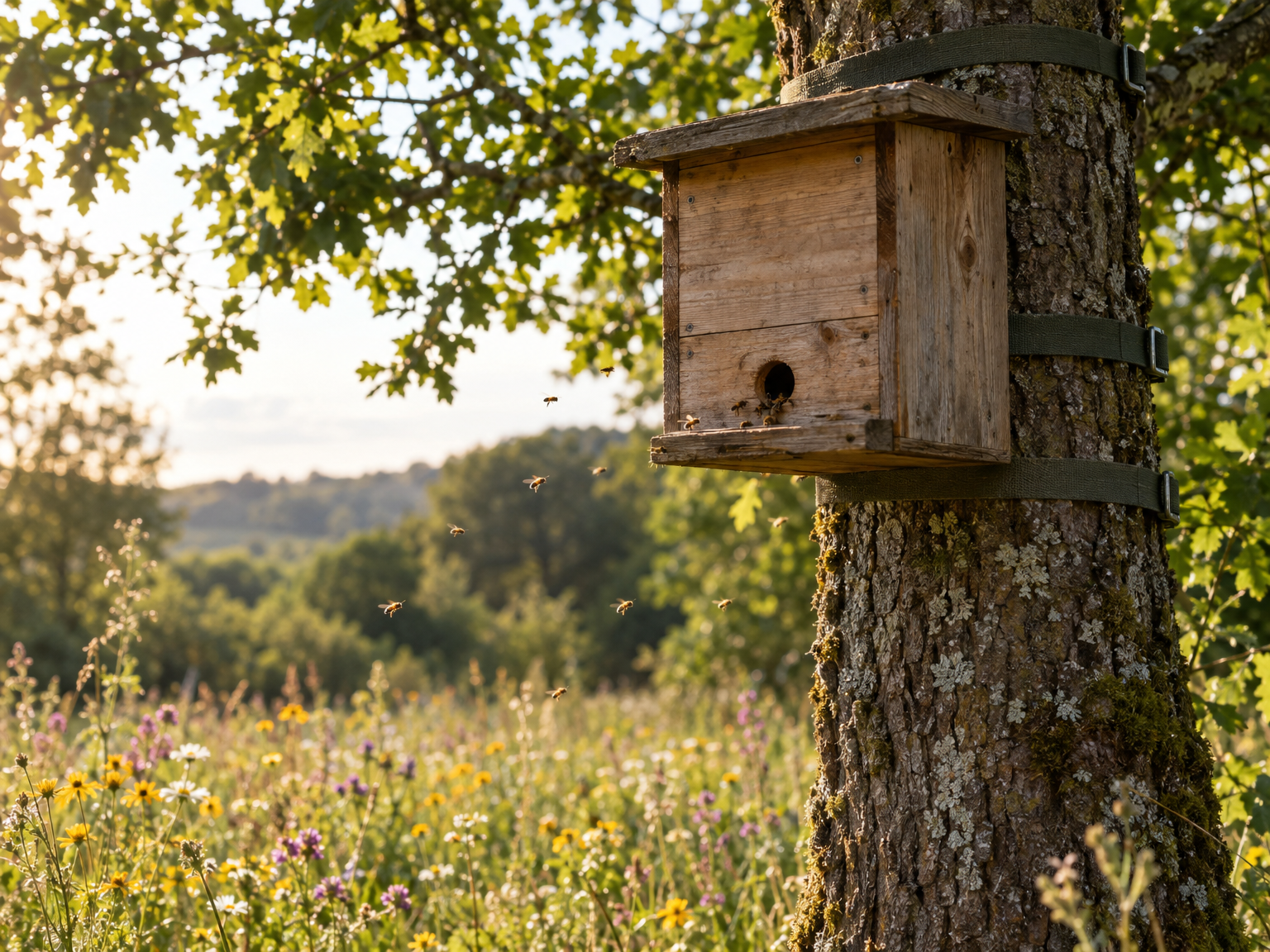
Buying bees, feeding them sugar and hanging a trap the wrong way round are the usual ways a first season goes wrong. This page takes the mistakes named in the video one at a time, says why they happen and what they cost, then gives the fix: a baited trap about 10 feet up a tree that catches a local swarm for nothing.
Measurements and timings below come from the demonstration.
- Price of a bought nuc
- $150–250
- Best trap height
- 10 ft
- Hang after first bloom
- 4–6 weeks
- Move distance if not under the tree
- 3–5 miles
What goes wrong
The nine mistakes, one by one
Each card names the mistake, why it happens, what it costs, and the fix that replaces it.
- 01
Buying package bees or nucs
- Why it happens
- Conventional advice and retail classes push bought stock, at roughly $150 to $250 a nuc.
- What it costs
- Trucked-in bees from another climate are not adapted to your weather, often need feeding and mite treatments, and frequently die over winter.
- Do this instead
- Bait local feral swarms. They survived selection where you live, forage your flows and can be multiplied with splits.
- 02
Keeping new colonies on sugar water
- Why it happens
- Beginners are taught that a new colony must be sustained with syrup.
- What it costs
- Feeding props up weak stock, masks poor genetics and builds dependency instead of a colony that can forage.
- Do this instead
- Start with a local swarm caught during a flow. It draws comb and builds on what is flowering, not on a feeder.
- 03
Snapping frame wires while assembling
- Why it happens
- Gripping the wire at an angle with pliers puts all the stress on one point.
- What it costs
- Loose foundation sags or tears once comb and honey are hanging on it.
- Do this instead
- Wrap the end 3 or 4 times round the anchor nail and sink it flush, clamp the free end flat so you pull straight, work the slack through each span, then wrap and drive the far nail. The wire should ring like a guitar string.
- 04
Burning through wax with an electric embedder
- Why it happens
- Counting seconds instead of watching the wax.
- What it costs
- A hot wire cuts the sheet like a cheese wire and the frame is scrap.
- Do this instead
- Use low-voltage direct current, about 19.5 V and 6.7 A from an old laptop supply. Touch the contacts, watch the sheet, and break contact the moment the wire stitches show through, usually 10 to 15 seconds.
- 05
Scenting the trap wrong, or letting the lure dry out
- Why it happens
- Bare wood has no hive smell, pinholes in lure tubes leak too fast, and open cotton balls dry within days.
- What it costs
- Scouts ignore the box, or read the wrong scent concentration and move on.
- Do this instead
- Melt raw propolis onto the entrance, walls and floor with a warm knife. Fill two slow-release polymer tubes halfway with lemongrass oil and hang them low on frame 3 or 4, near the entrance. No pinholes: vapour passes through the tube wall for up to a year.
- 06
Leaving frames loose in the trap
- Why it happens
- The box is hung with the frames able to slide.
- What it costs
- Frames rattle and knock in wind or in transit, crushing bees and unsettling a new colony.
- Do this instead
- Fit a wooden spacer against the first frame and drive a wedge at the other end so all six frames lock together.
- 07
Traps on the ground, or dangerously high
- Why it happens
- Blocks on the ground are convenient, and high climbing feels like it must be better.
- What it costs
- Ground traps are ignored because bees avoid ground predators, and above 10 feet the risk climbs with no gain in catch rate.
- Do this instead
- Hang the trap about 10 feet up in a solid tree. Catches rise sharply to 10 feet and show no real improvement above it.
- 08
Hanging the trap out of plumb or leaning back
- Why it happens
- Tree trunks are rarely straight, so the box tilts.
- What it costs
- Rain runs into the entrance, and bees drawing from starter strips build along gravity instead of along the frames.
- Do this instead
- Check with a pocket level. Shim between trunk and box until it is plumb side to side and leaning slightly forward, so water sheds away from the entrance.
- 09
Moving a fresh swarm a short distance
- Why it happens
- The trap comes down and the hive goes 50 to 100 yards away in the same apiary.
- What it costs
- Foragers are locked to the tree’s position, fly back to nothing and drift or abandon the box.
- Do this instead
- Either put the permanent hive directly under the trap tree, or close the entrance at dusk, strap the box and move it 3 to 5 miles away for 2 to 5 days before bringing it home.
The trap
A box a swarm chooses
Six deep frames, wax foundation, a propolis-scented interior and lemongrass vapour. Scouts measure a cavity by spiralling in and out of the entrance, so the entrance, the height and the lean all matter as much as the box.
Wiring and embedding is where most traps get ruined: a wire pulled at an angle snaps, and an electric embedder left on for one second too long cuts the sheet in half.
- Trap box
- 6 deep frames, Layens and horizontal-hive size
- Frames
- Full sheets of pure beeswax foundation on tensioned wire
- Ventilation
- Gap above the frames plus holes in the lid
- Lid security
- Heavy-duty hasp or toggle latches
- Lure
- 2 slow-release tubes, half-filled with lemongrass oil
- Scent base
- Raw propolis melted into the walls, floor and entrance
- Mounting screw
- T25 star-drive screw, half an inch proud, angled slightly up
- Height
- About 10 feet: higher adds risk, not catch rate
The lure
Propolis, then lemongrass
- · Heat a drywall knife over a flame and melt raw propolis into the entrance, walls and floor.
- · Fill two polymer slow-release tubes halfway with lemongrass oil and leave the air headspace.
- · Hang them low on frame 3 or 4, on the entrance side. Vapour passes the tube wall for up to a year.
- · Lemongrass shares its key compounds with the Nasonov pheromone bees use to guide a swarm home.
The embedder
An old laptop supply, watched not timed
- · About 19.5 V and 6.7 A, roughly 120 to 130 W of direct current.
- · Use the black and white conductors and leave the earth wire out of the circuit.
- · Touch the contacts to the wire ends and watch the wax: when stitches appear, break contact.
- · Ten to fifteen seconds is typical. Do not count seconds and walk away.
Timing and moving
When to hang it, and where it can go
Your region: Gauteng
Hang traps 4 to 6 weeks after the first spring flowers open. Here that is late august to september: first inspections once the last frost has gone and the wattles and oaks start to open, with swarms usually flying October to December, as the first rains arrive and the jacarandas come into flower. Check every 1 to 2 weeks: six frames hold a colony for about 3 weeks before it needs more room.
Change region in the colony planMoving a catch
- Option A. Put the permanent hive directly beneath the trap tree. No move, no drift, no lost foragers.
- Option B. Close the entrance at dusk, strap the box, move it 3 to 5 miles away for 2 to 5 days, then bring it back anywhere you like.
- Never move it 50 to 100 yards in the same apiary: foragers return to the tree and the box empties.
Your trap
Build and hang it in one list
0 of 10 done · 0%
Build
Scent
Hang
Timing
Trap log
What the trap caught
Check the box every few days. Scouts, queen cells and the day you close the trap are what tell you when a swarm is moving in.
A caught swarm still needs a record.
Give the new colony a profile, note the trap tree and the date, and follow its first season in the diary.